Venue Guide
Getting Married at Calamus Estate Winery: A Photographer's Guide
Calamus asks you to photograph two opposite rooms in one evening. A lawn on top of the escarpment with an open sky and no shade in it, and a barn that turns very dark the moment the sun goes down. Plan for one and you lose the other.
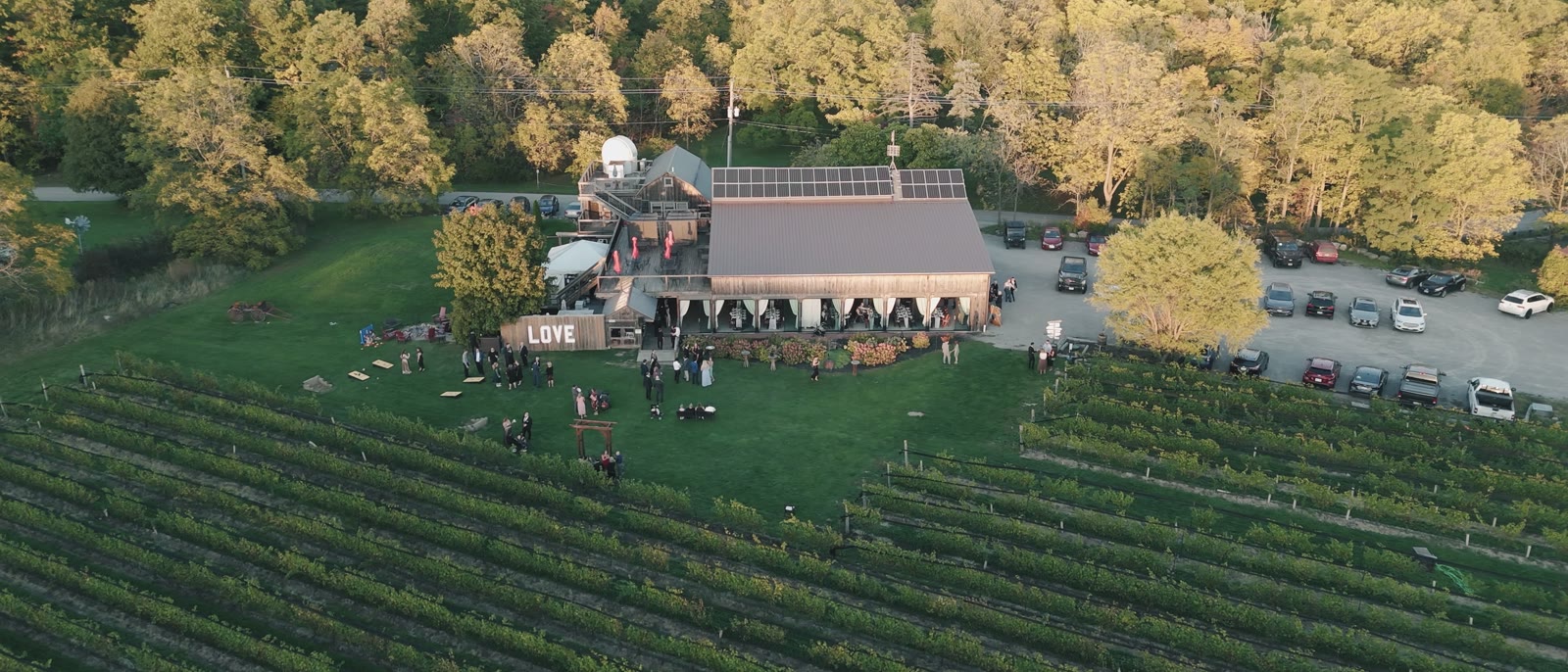
Most Niagara wedding venues sit on the flat between the escarpment and the lake. Calamus does not. It is up on the Niagara Escarpment in Jordan Station, with about twenty acres of vineyard around it and Ball's Falls conservation area next door.
That elevation decides almost everything about the photographs. It gives you an open western sky with nothing in front of it, which is the most valuable thing a wedding venue can own. It also gives you a ceremony lawn with no shade anywhere on it, at exactly the hour most couples want to get married.
Here is how the day actually behaves, room by room.
The ceremony happens on the lawn, and the lawn faces the sky
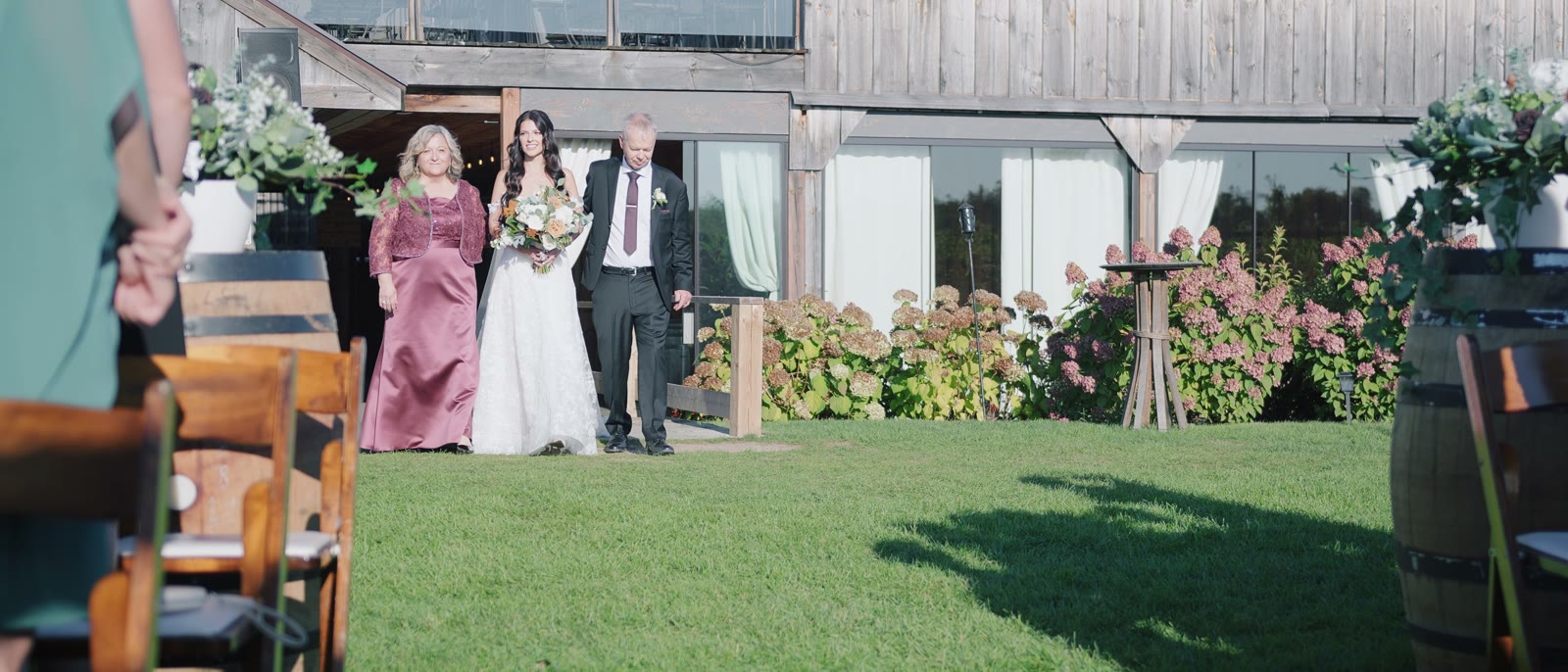
Ceremonies here run outdoors on the grass beside the barn: wooden chairs on the lawn, a floral arch, hydrangeas along the edge, and the vineyard falling away behind everything. It is a genuinely beautiful set-up and it has one specific demand — there is no tree canopy over any of it.
An outdoor ceremony under a high sun gives you top light. Shadows sit in the eye sockets, a hot line burns along the shoulders, and a white shirt runs a stop and a half brighter than the face beside it. A photographer can work with this, and I do, but nobody would choose it.
Push the ceremony an hour or two later and every one of those problems solves itself. The sun drops toward that open western horizon, light arrives sideways instead of from overhead, and the vineyard stops being a green field and becomes rows of backlit leaves. Same lawn, same arch, completely different photograph.
Sunset in Jordan Station, roughly
Late June, a little after 9pm. Late September, around 7:15pm. Late October, around 6:15pm. Check the exact date for your year — a 5pm ceremony in June and a 5pm ceremony in October are two different weddings.
Golden hour in the rows is shorter than you think
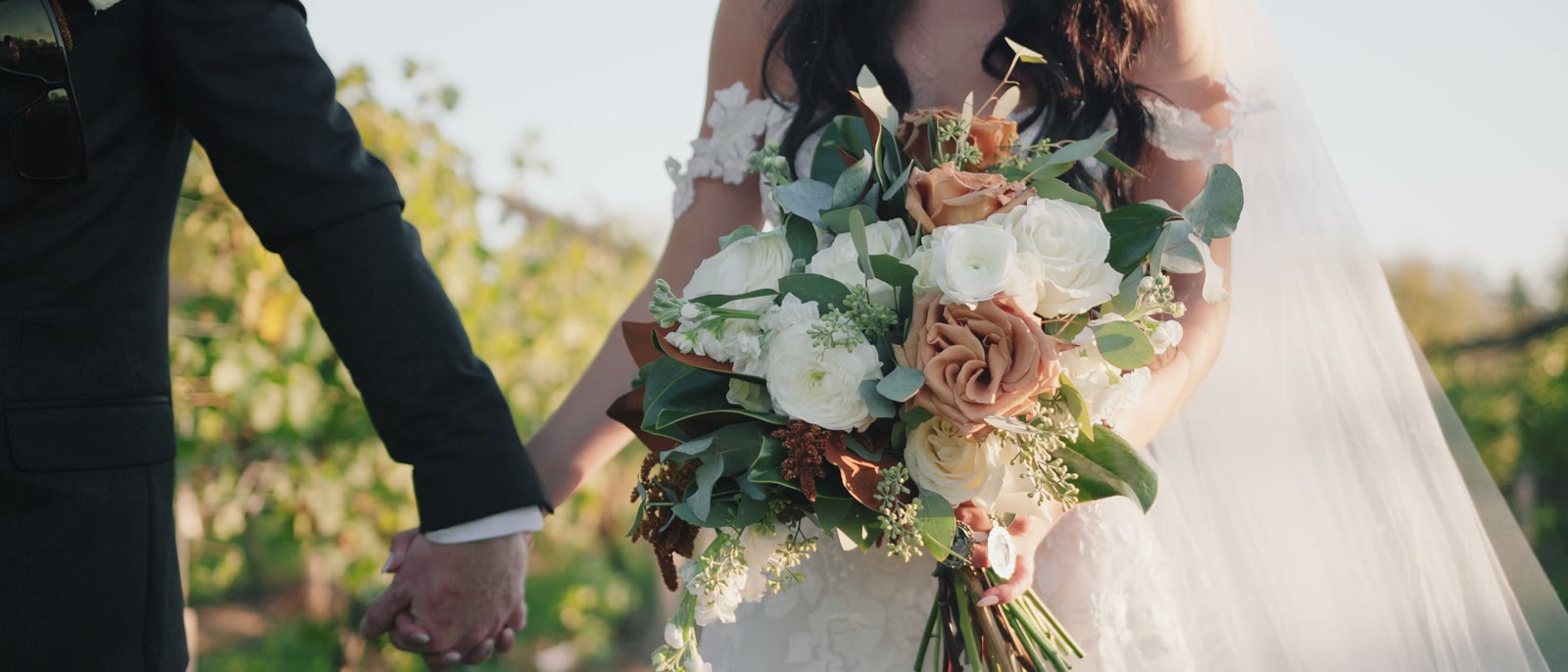
This is what you are buying when you book a vineyard, and on a clear evening the good light lasts about thirty to forty minutes. The best of it is the last fifteen.
Thirty minutes is plenty if you have already been photographed and are only stepping out for the light. It is nowhere near enough if this window is also carrying your family formals, your wedding party and your first look. Protect it by moving everything else out of it.
One practical note about the rows: they read completely differently depending on which way you stand. With the rows running away from camera you get receding lines and depth. Standing across them you get a flat wall of green with no perspective at all. Your photographer should be walking the vineyard before you arrive, finding where the light and the lines agree.
The barrel room
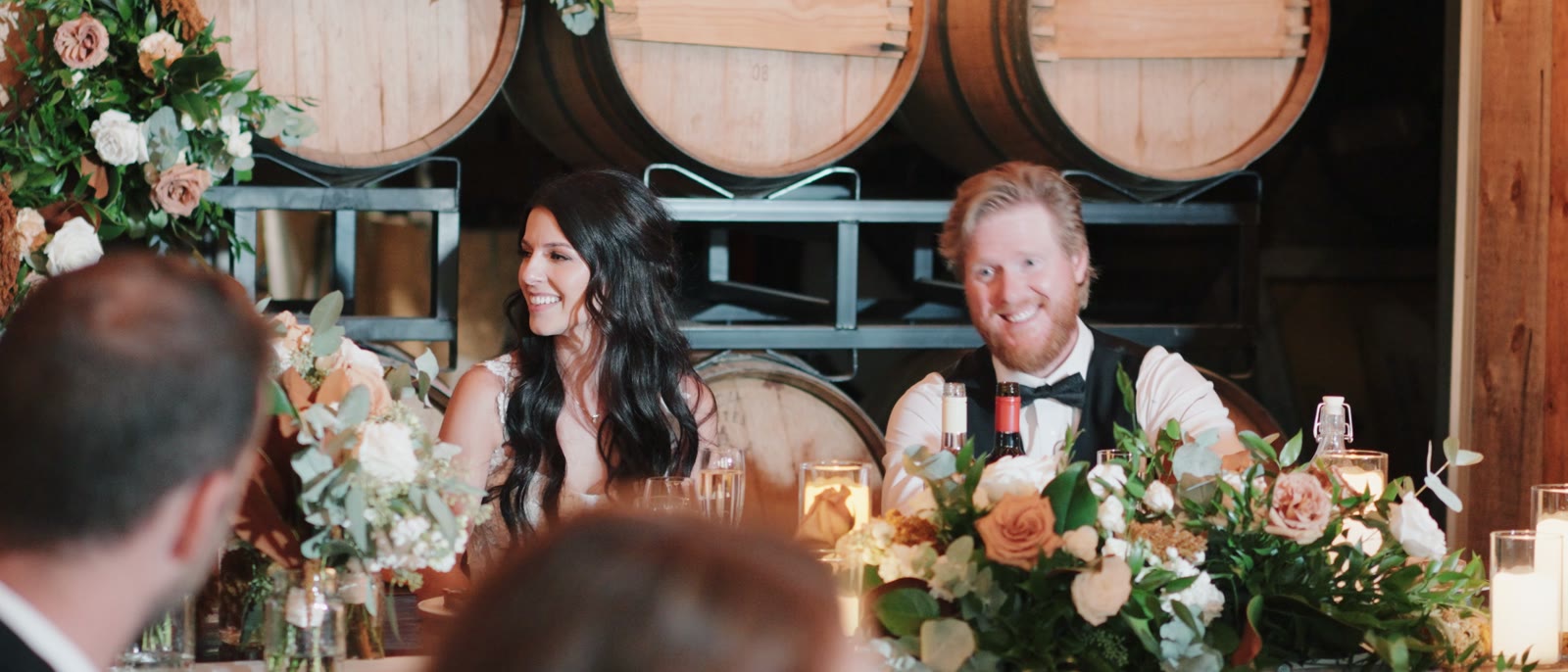
The barrels are the thing this venue has that no ballroom in the GTA can copy. A head table set against three tall oak barrels gives you a backdrop with real texture and real scale, and it is unmistakably Niagara.
It is also a lighting trap, in a friendly way. Oak, candles and warm uplighting look wonderful to your eye, but the barrels absorb rather than reflect, and candlelight is a fraction of what a camera needs. Photographs here work when someone has put a small, warm light in the right place before anyone sits down — not when someone fires a flash across the room during the speeches.
The barn changes character at sunset
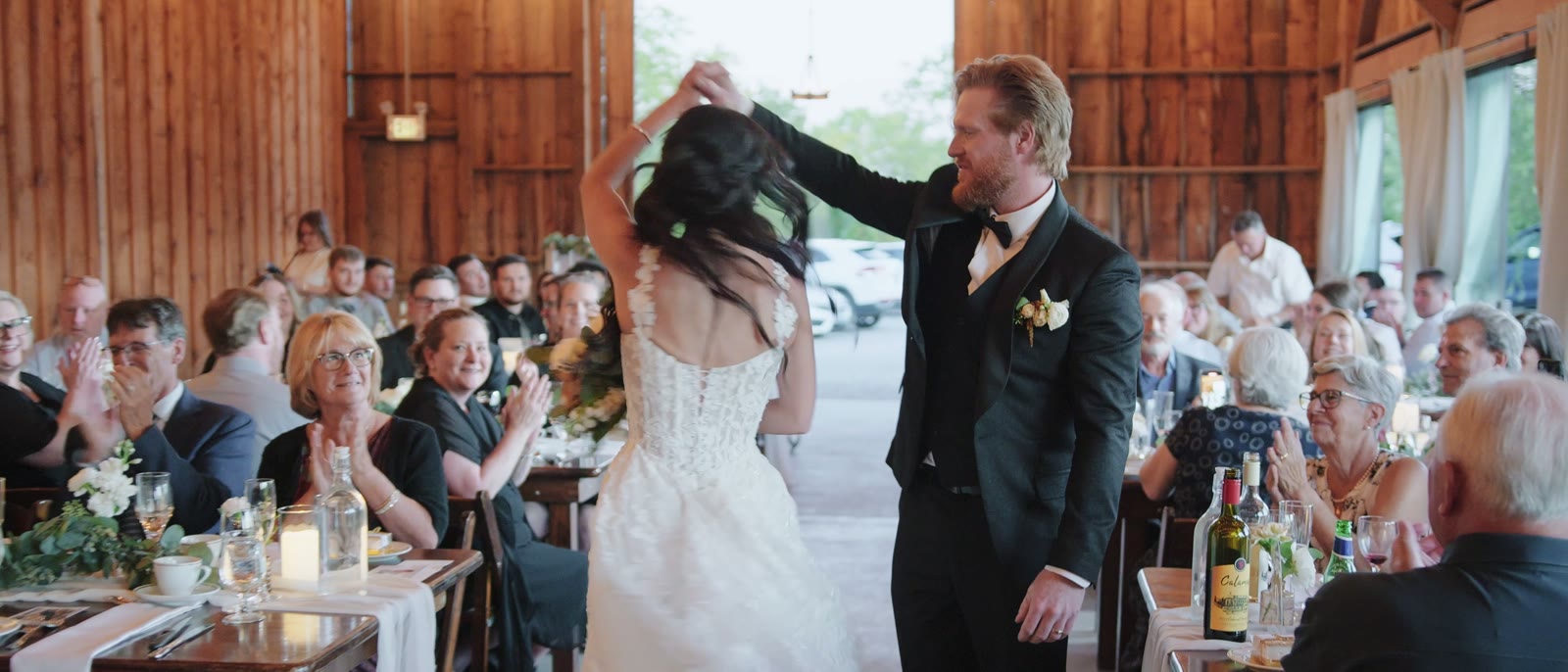
The barn is a renovated historic building — wooden interior, high ceiling, climate controlled, tall windows down both long walls. That last detail matters more than people expect, and it is the thing most guides about barn weddings get wrong.
Before sunset, those windows carry the room. Dinner that starts while there is still light outside is photographed on daylight, and it looks soft and natural without anyone adding anything.
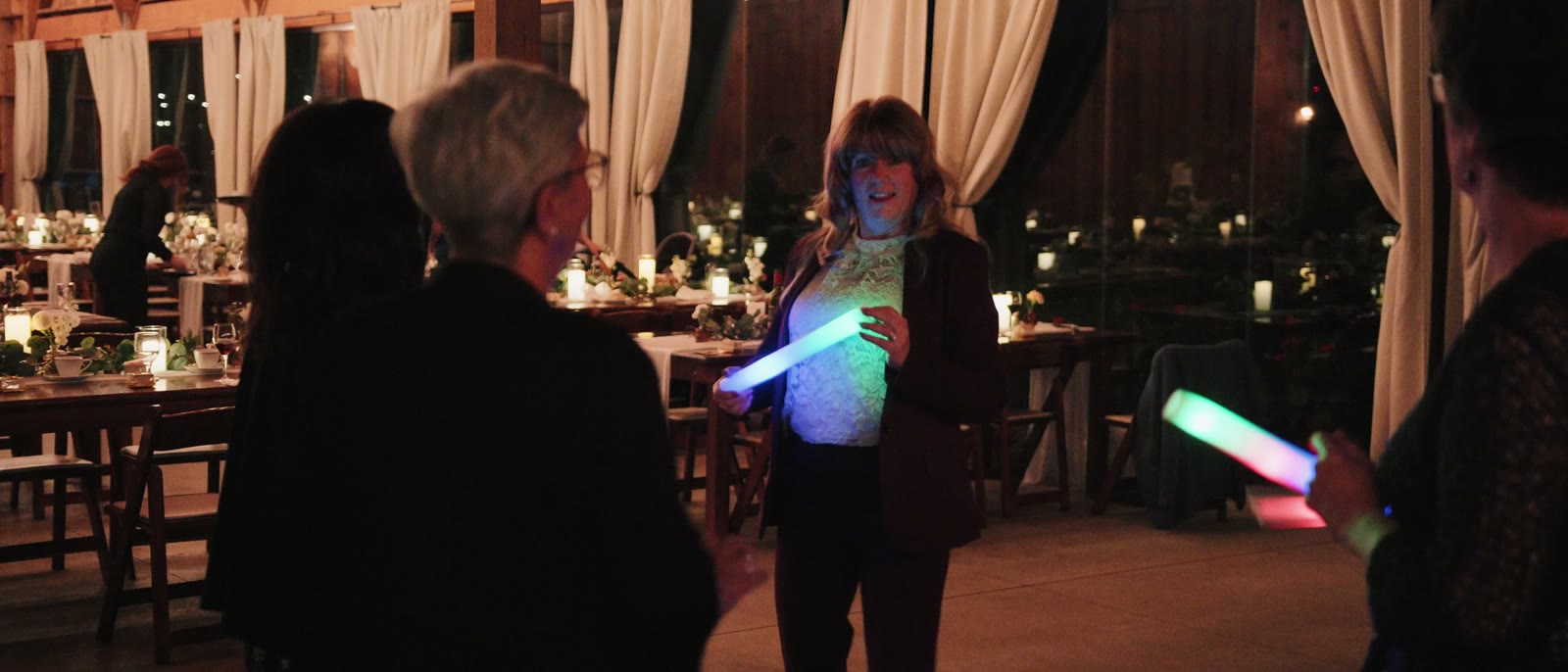
After sunset the room is a different building. Every surface is dark wood, which absorbs light instead of bouncing it, and the ceiling is too high and too dark to bounce a flash off. This is the opposite of a hotel ballroom, where a photographer can point a flash at a white ceiling and light the whole room by accident.
So the barn after dark is not a problem to solve on the night. It is a decision made an hour earlier. I set a small number of low, warm sources before guests come in, aimed to keep the wood glowing and to separate faces from it, then leave them alone and go back to photographing people.
A dark barn is not a problem you solve at 10pm. It is a decision you made at 6pm.
The film
Michelle and Joel married here in early autumn. This is their film, and it is the most honest answer I can give to what the venue looks like across a full day — the lawn, the rows, the barrels, and the barn once the lights come on.
Where the photographs actually happen
- The ceremony lawn. Open grass, the barn on one side, vineyard behind. Also the best spot for large group photographs, because it is the only place with room to stand back far enough.
- The rows nearest the building. You do not need to walk to the far end of twenty acres for the vines to look endless. A hundred metres is enough, which matters when the light is going.
- The edge where the land drops away. This is what Calamus has that a flat vineyard does not — open distance behind you, and depth a level field cannot give.
- The barn porch and the weathered board walls. Shade in the middle of the day, and a hard-edged texture that works when the sky is flat and white.
- The barrel room, empty. Set, lit, nobody in it. You get this photograph once, and only if somebody books ten minutes for it.
- Ball's Falls, next door. Stone, water, mature trees — a completely different texture from anything on the property.
Before you count on Ball's Falls
It is conservation land managed separately from the winery, and photography there can need permission, a permit or a fee, with its own opening hours. Ask both the winery and the conservation authority before you build it into a timeline.
Timeline advice that holds up
Work backwards from sunset. At a venue whose best asset is an open western sky, sunset is the only appointment of the day that cannot move. Fix it first, then place the ceremony, then place hair and makeup.
Do not put portraits at midday on an open lawn. If the schedule forces it, use the barn porch or go inside, and save the vineyard for the evening. A vineyard photograph at 1pm and one at 8pm are not the same product.
Do the family formals immediately after the ceremony, on the lawn. Everyone is already there and nobody has gone looking for a drink yet. Twenty minutes here buys you the whole golden hour later.
Book ten minutes in the barn before doors open. Tables set, candles lit, room empty.
Ask what time the music stops. Rural venues often have earlier noise curfews than city ones. If music ends at 11pm then the last dance is at 10:45pm, and that changes when speeches and cake should sit.
Weather on top of an escarpment
It is more exposed up here than down on the flat, and the wind is stronger and steadier than the forecast for St. Catharines suggests. Veils, long hair, loose stationery and light table decor all need a plan for anything outdoors.
Temperature drops fast after sunset in spring and autumn, faster than guests dressed for a summer wedding expect. A wrap for the evening portraits reads as styling rather than compromise, and it means the best light of the day gets used instead of skipped.
The compensation is that rain here is far less punishing than at a venue whose only space is a tent. The barn is climate controlled and worth photographing in its own right. A wet day costs you the vineyard portraits, not the wedding.
Why this venue suits documentary coverage
I photograph candidly. I do not arrange people into lines and I do not stop a room to manufacture a moment. Calamus makes that straightforward for two reasons.
The first is that everything happens within a short walk. Ceremony on the lawn, drinks outside it, dinner and dancing in the barn beside it. The wedding never splits into two parties in two buildings, and you never lose forty minutes to driving somewhere for portraits.
The second is that the barn is one room with a defined shape. Once the lighting is set early there is nothing between me and the people in it. Half of documentary photography is standing in the right place before the thing happens, and a venue with one good room makes the right place easy to find.
A note on booking
Calamus runs an inclusive package — venue rental with the ceremony included rather than charged separately, an event planner and on-site event manager, harvest tables with linens, and a DJ. Confirm the current details with them directly, because packages change year to year.
Two questions worth asking on your tour, because both affect photography more than anything else on the contract: what time you get access to the barn for setup, and what the wet-weather plan is for the lawn ceremony — specifically where it moves to, and how much notice you have to make the call.
On capacity, published figures vary between sources, with the barn described as holding up to about 180 guests and other listings quoting a lower seated number. Get your number in writing from the venue rather than from a directory.
If you are still shortlisting, I have written the same kind of guide for Spencer's at the Waterfront and The Pearle Hotel, and an honest breakdown of what a wedding photographer costs in 2026, including where my own pricing sits inside that range.
Enquiries
Marrying at Calamus?
I take twenty to thirty weddings a year, which means I am either free for your date or I am not. Tell me when you are getting married and I will tell you straight away.
Check your dateOr see the rest of The Endless Love and the journal.
References
- Calamus Estate Winery, Weddings — the barn, ceremony options and package inclusions.
- WeddingWire Canada, Calamus Estate Winery — capacity listings and reviews.
- WeddingHero, Calamus Estate Winery, Jordan Station — venue overview.